
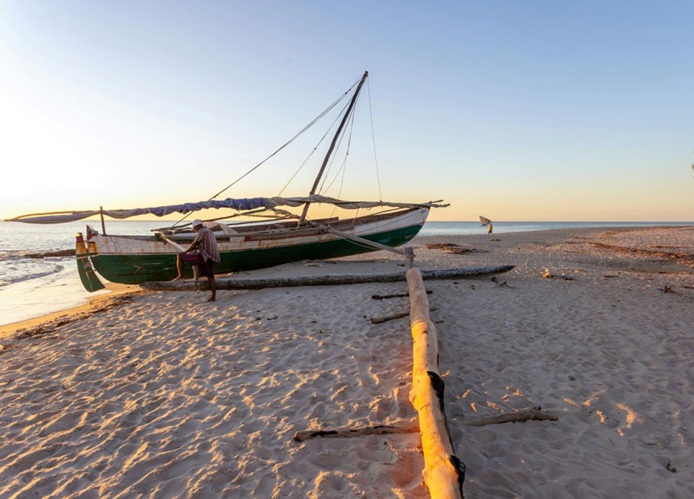
Madagascar doesn’t try to resemble other destinations. From the start, it feels distinct — not because it rejects comfort, but because it organizes life around something else. Nature isn’t curated or arranged to impress. It’s simply present, shaping how places function and how days unfold.
For travelers open to that balance, Madagascar offers a rare kind of clarity: the sense of being in a place where the environment genuinely matters.
Here, nature isn’t decoration. It’s structure.
An Island That Evolved on Its Own
Separated from mainland Africa millions of years ago, Madagascar followed its own path. Over time, isolation produced an ecosystem unlike any other, where plants and animals evolved independently and became the norm rather than the exception.
Walking through Madagascar’s forests feels unfamiliar in a good way. Vegetation grows in forms you don’t immediately recognize. Sounds are subtle, layered. Even quiet feels active, as if the landscape is constantly at work. You’re not standing outside nature — you’re moving within it.
Landscapes That Reward Time
Madagascar’s landscapes don’t compete for attention. They reveal themselves gradually. Dry southern regions transition into dense eastern rainforests. Central highlands reflect agricultural life shaped by terrain. Coastlines extend calmly, without interruption.
Nothing feels staged. There’s no single “moment” you’re meant to capture. Instead, the experience builds through repetition — the same road, the same light, the same view seen slightly differently each day. It’s less about impact, more about familiarity.
Wildlife Experienced Naturally
Encounters with wildlife in Madagascar feel genuine because they aren’t orchestrated. Lemurs appear when they’re active. Chameleons blend into their surroundings until you learn how to see them.
This encourages attentiveness. You slow down. You look more carefully. When an animal does come into view, the moment feels quiet and authentic, shaped by observation rather than expectation.
Daily Life Connected to the Landscape
What stands out in Madagascar is how closely daily life remains linked to the natural environment. Villages follow the land. Agriculture adapts to seasons and climate. Movement responds to weather and terrain.
Rather than separating human activity from nature, the two coexist visibly. For visitors, this creates a strong sense of coherence. You’re not just passing through scenery — you’re seeing how people live within it.
Travel That Encourages Flexibility
Traveling in Madagascar naturally invites flexibility. Distances can feel different than expected. Routes take time. Days tend to open up rather than compress.
This isn’t a drawback — it’s part of what allows the journey to breathe. Certain destinations make it clear that scale and geography shape the experience. Observing how a journey unfolds across a landscape as varied as Madagascar — for instance through a seven-day itinerary in Madagascar — helps recalibrate expectations, highlighting how environment often sets the rhythm of travel more than planning does.
Not as a comparison, but as context. Madagascar operates on a scale that encourages adaptation in a constructive way.
Quiet as Part of the Experience
One of Madagascar’s most distinctive features is its soundscape. There’s no constant background noise. Evenings settle naturally. At night, sounds come from insects, wind, or distant movement.
This quiet isn’t emptiness. It’s balance. It allows attention to rest without forcing introspection. You don’t feel removed from the environment — you feel included in it.
Why the Experience Lasts
Madagascar doesn’t rely on spectacle to stay memorable. Its impact comes from consistency — landscapes that remain present, rhythms that settle in, moments that aren’t rushed.
You leave with fewer highlights and more continuity. With a clearer sense of pace. With a refreshed way of relating to space and time. Where nature leads, the experience feels grounded rather than overwhelming.
That steady alignment is what makes Madagascar linger in memory.


